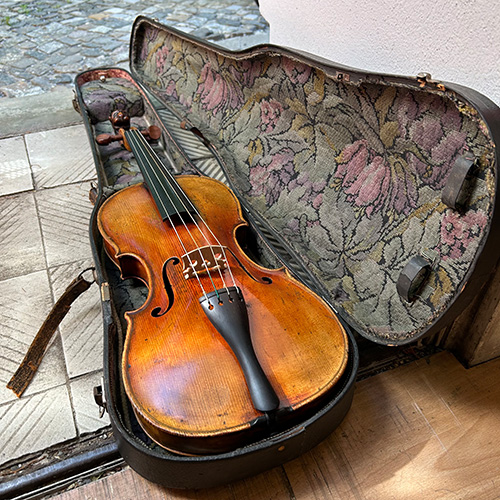
The Stradivarius from the Attic
Originals, Copies, and Deliberate Deception
Every now and then, customers bring violins into my workshop that they have inherited or discovered tucked away in an attic. Very often these instruments bear a label reading “Antonius Stradivarius Cremonensis Faciebat Anno …”, which naturally raises hopes of an extraordinary discovery.
In reality, however, the chances of stumbling upon a previously unknown original Stradivari are exceedingly slim. In most cases, these are trade instruments manufactured in and around Markneukirchen, Saxony, during the 20th century. Produced in large numbers and frequently exported overseas, they can often be identified by markings such as “Made in Germany” or “Made in GDR.”
On these so-called German trade instruments, such labels should not be interpreted as an attempt at forgery. Rather, they simply indicate the model on which the violin was based. Alongside Stradivari, makers such as Amati, Guarneri, and Maggini also served as common sources of inspiration. Their characteristic stylistic features were often reproduced only in broad outline, as convincingly imitating the varnish, scroll, and overall craftsmanship of these great masters requires exceptional skill and an artistic approach far beyond the realities of mass production.
Occasionally, however, I encounter instruments whose labels have been deliberately altered to deceive. One memorable example was a violin bearing a Gagliano label dated 1791, accompanied by what appeared to be a convincing certificate of authenticity. A dendrochronological examination of the spruce top told a different story: the youngest growth ring dated from 1923. Allowing for the customary seasoning period of the wood, the instrument could not have been built before approximately 1928 or 1929 – remarkably, the very same period in which the certificate had been issued. In this case, there was little doubt that the intention had been to mislead.
Another interesting case involved a violin labeled “Chipot-Vuillaume, Gendre de J.-B. Vuillaume à Paris.” The maker in question did indeed bear that name and was the son-in-law of a Jean-Baptiste Vuillaume – but not the celebrated violin maker whose instruments command six-figure prices today. Instead, his father-in-law was a shoemaker. A clever piece of marketing that continues to cause confusion more than a century later.
Whenever there is uncertainty about an instrument, I always recommend seeking a professional opinion, regardless of its monetary value. After all, the true significance of an inherited violin often lies not in its market price, but in the story it carries.
Whether your instrument proves to be an original or a copy, I would be delighted to examine it with you. Together we can uncover its history – and bring its voice back to life.